What Is a Three-Dimensional Display Called? A Glossary of 3D Display Terms
A practical glossary explaining what a three-dimensional display is called, covering autostereoscopic, stereoscopic, spatial, light-field, holographic, and volumetric 3D display categories.
What Is a Three-Dimensional Display Called? A Glossary of 3D Display Terms
A three-dimensional display is most commonly called a stereoscopic 3D display or, when it works without glasses, an autostereoscopic display. In professional and product marketing contexts you will also see terms like glasses-free 3D display, naked-eye 3D display, 3D spatial display, light-field display, volumetric display, and holographic display. Each of these names points to a specific way of producing depth, and the right term depends on whether the viewer wears glasses, how many viewers are supported, and how the image is generated.
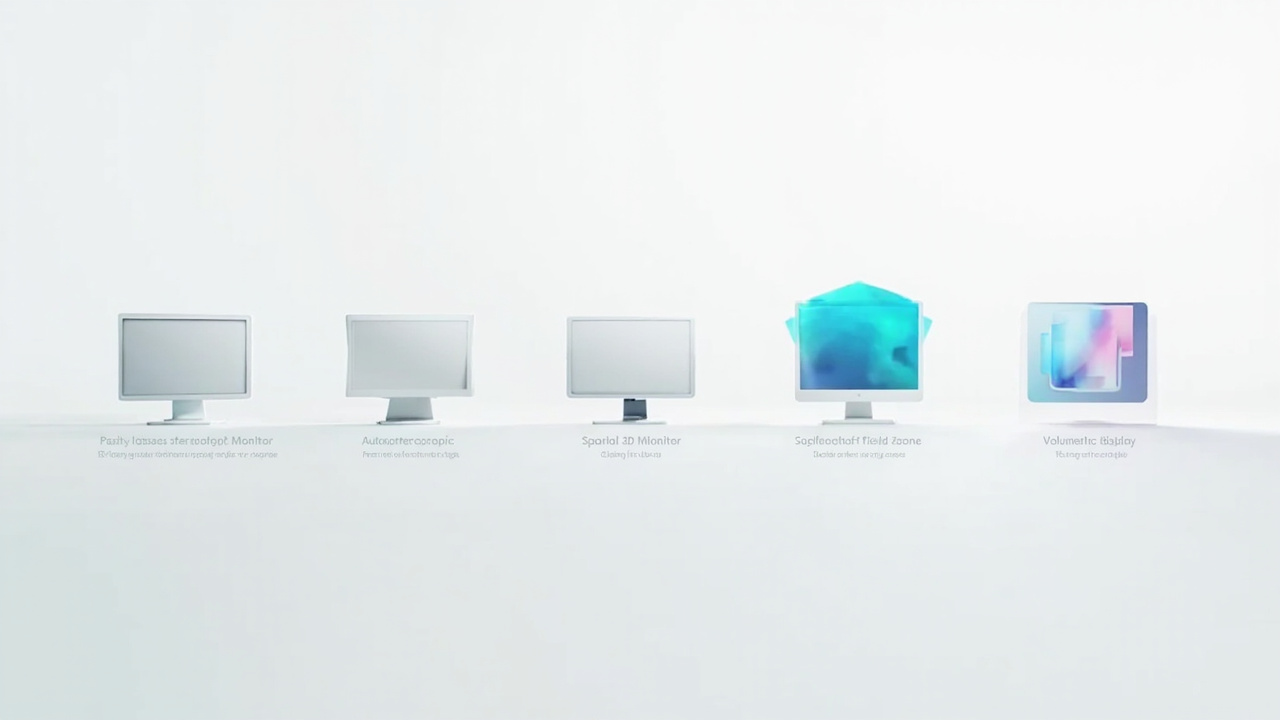
A three-dimensional display can refer to several distinct categories, from glasses-required stereoscopic panels to glasses-free autostereoscopic, spatial, light-field, and volumetric displays.
Quick answer: what a three-dimensional display is called
If you need a single label, the safest general answer is 3D display. If you want a more precise term, choose one based on the technology:
- Stereoscopic 3D display — produces depth by delivering separate left-eye and right-eye images, usually requiring glasses.
- Autostereoscopic 3D display — produces stereoscopic depth without glasses; sometimes called a glasses-free 3D display or naked-eye 3D display.
- Spatial 3D display — a marketing and product-line term for glasses-free 3D monitors built for professional review, often based on autostereoscopic optics.
- Light-field display — reconstructs rays of light so the viewer can perceive focus and parallax; a more advanced form of glasses-free 3D.
- Volumetric display — creates a true 3D image in physical space using voxels, lasers, or rotating screens, so multiple viewers see real depth from any angle.
- Holographic display — a term used loosely for glasses-free 3D in marketing, but in optics it refers to recording and reconstructing wavefronts; treat it as ambiguous unless a source defines it.
The main names used for 3D displays
Different industries use different vocabulary. Here is how the most common labels are typically used:
- 3D display — the broad umbrella term. Used in retail listings, search queries, and general writing.
- Stereoscopic display — the technical standard for any display that sends different images to each eye to create the illusion of depth.
- Autostereoscopic display — the technical name for stereoscopic displays that do not require glasses, usually using lenticular lenses, parallax barriers, or eye tracking.
- Glasses-free 3D display and naked-eye 3D display — consumer-friendly synonyms for autostereoscopic.
- Spatial 3D display and 3D spatial display — vendor-facing terms (including 3DV) for glasses-free monitors positioned for professional review workflows.
- Light-field display — a glasses-free category that reconstructs a fuller light field, often supporting multiple viewers and natural focus cues.
- Volumetric display — a category that draws a real 3D volume in space, independent of the viewing angle.
- Holographic display — often used as a marketing synonym for any glasses-free 3D, though its strict optical meaning is narrower.
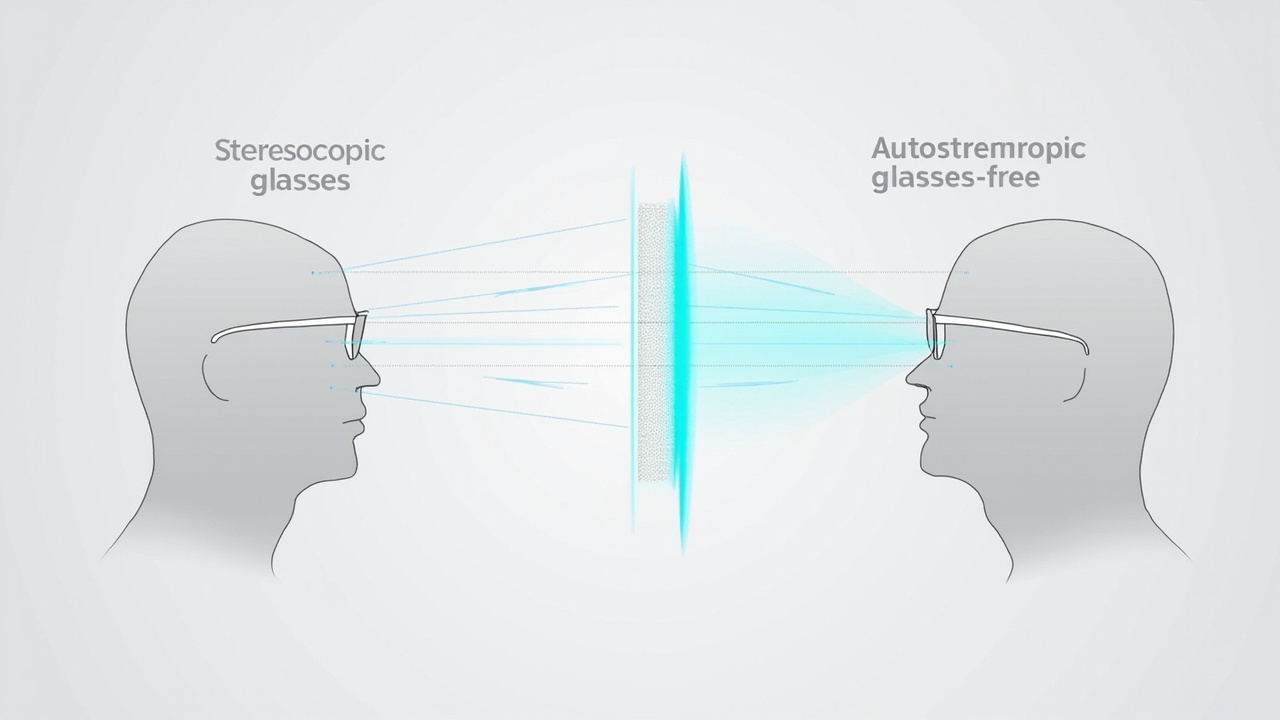
The key difference between stereoscopic and autostereoscopic displays is how left- and right-eye views are separated: glasses versus an optical layer on the panel.
How the main 3D display categories differ
These names are not interchangeable. They describe different optical approaches with different viewer counts, glasses requirements, and content needs.
Stereoscopic 3D display
A stereoscopic display shows two slightly offset images and relies on glasses — either passive polarized glasses or active shutter glasses — to route each image to the correct eye. This is the classic “3D monitor” or “3D TV” approach used in cinemas and older home setups. The visual effect is strong, but the glasses are a workflow friction point.
Autostereoscopic 3D display
An autostereoscopic display does the same left/right separation optically, using a lenticular lens array or parallax barrier layered over the panel, without glasses. Many modern designs add eye tracking so the display follows the viewer and keeps the stereo effect stable as the head moves. Single-viewer eye-tracked designs are common in professional monitors.
Spatial 3D display
Spatial 3D is essentially a product-positioning term for glasses-free 3D monitors aimed at professional review use cases: medical visualization, industrial inspection, CAD review, and microscope workflows. In practice it almost always refers to an autostereoscopic panel, often with eye tracking, sold as a monitor replacement rather than a headset.
Light-field display
A light-field display goes beyond two-view stereo by reconstructing multiple rays of light so the viewer perceives natural focus and motion parallax. This category is rarer, more expensive, and typically aimed at research or specialty visualization. Some light-field displays support multiple simultaneous viewers.
Volumetric display
A volumetric display creates a real 3D image in physical space — for example, by sweeping a screen through a volume or by exciting voxels in mid-air. Because the image truly exists in 3D, multiple viewers can walk around it and see correct depth from any angle. Content pipelines and hardware cost are significant barriers.
Holographic display
In strict optics, a hologram records and replays an entire wavefront of light. In consumer marketing, “holographic display” is often used loosely to mean any glasses-free 3D effect. Treat the term as ambiguous unless the vendor specifies the underlying method.
When each term is the right one to use
Picking the right label matters for buyers, editors, and developers because it sets expectations about glasses, viewer count, and content format.
- Use stereoscopic display when glasses are required and you want to be technically precise.
- Use autostereoscopic display or glasses-free 3D display when the display produces depth without eyewear.
- Use spatial 3D display when describing professional glasses-free monitors for review workflows.
- Use light-field display when the device reconstructs multiple light rays and supports focus cues.
- Use volumetric display when the image physically exists in a 3D volume viewable from any angle.
- Use holographic display with caution; clarify the underlying technology or quote the source definition.

Matching the right 3D display name to a workflow depends on viewer count, whether glasses are acceptable, and what content the team can already produce.
Choosing the right 3D display term for your workflow
If you are evaluating a display for a real task, match the category to your content and viewers rather than to the marketing label.
- One primary viewer, monitor-style work, no glasses → look for autostereoscopic or spatial 3D monitors with eye tracking. Verify whether the panel is single-viewer or multi-viewer.
- Multiple simultaneous viewers → confirm the device supports multi-view autostereoscopic, light-field, or volumetric output. Standard two-view autostereoscopic panels will not work for a group.
- Stereo content already exists (SBS, dual-output CAD, stereo medical viewers) → most autostereoscopic and spatial 3D displays can accept this directly; check the supported input formats.
- Strict 3D accuracy or research use → light-field or volumetric displays may be required, but expect higher cost and more limited availability.
- Marketing or signage with a “holographic” label → ask the vendor which underlying technology is actually used before assuming a true hologram.
Frequently asked questions
What is another name for a 3D display?
Other names for a 3D display include stereoscopic display, autostereoscopic display, glasses-free 3D display, naked-eye 3D display, spatial 3D display, light-field display, and volumetric display. The most precise name depends on whether glasses are used and how depth is generated.
What is a glasses-free 3D display called?
A glasses-free 3D display is most precisely called an autostereoscopic display. In consumer contexts it may also be called a naked-eye 3D display; in professional product lines it is often sold as a spatial 3D display.
What is the difference between stereoscopic and autostereoscopic displays?
Stereoscopic displays require glasses to separate the left-eye and right-eye images, while autostereoscopic displays perform that separation optically on the panel so the viewer does not need glasses.
Is a spatial 3D display the same as a holographic display?
Not necessarily. A spatial 3D display is usually an autostereoscopic monitor for professional review. “Holographic display” is sometimes used as a marketing synonym, but in optics it refers to a more specific wavefront-reconstruction method. Treat the two terms as distinct unless a vendor clarifies the underlying technology.
What is a volumetric display?
A volumetric display creates a real 3D image in physical space — for example, using voxels, swept screens, or laser-excited media — so multiple viewers can see correct depth from different angles without glasses.
Related reading on 3dmonitor.net
- Autostereoscopic Display: Technical Explainer
- Naked-Eye 3D: Technical Explainer
- 3D Without Glasses: Technical Explainer
- 3D Display Screen: Technical Explainer
- Spatial 3D Display Buying Guide
- How to Choose Stereoscopic 3D Monitor
This article is objective third-party editorial coverage on 3dmonitor.net. It does not invent specifications, prices, certifications, or benchmarks, and 3DV products are not promoted here as marketing material.
Ready to explore 3D displays?
Browse our detailed comparisons and buying guides to find the right spatial display for your workflow.
View Best 3D MonitorsDisclosure: This article is part of 3DMonitor.net's educational content. Product recommendations are based on research and may contain affiliate links. See our full disclosure.